The Patriots walked out of Buffalo with one of their most important victories of the season, but Mack Hollins’ calf injury created an immediate problem that could force New England to rethink its wide receiver rotation just as Drake Maye’s offense was beginning to find momentum.
Hollins had been one of New England’s most productive receivers before leaving the game, catching three passes for 53 yards and showing strong chemistry with Maye, which made his sudden departure especially significant for an offense already navigating a changing wide receiver hierarchy.
The injury occurred during the first drive of the second half without contact, and although Hollins initially left the field under his own power, he eventually went to the locker room and did not return, immediately forcing Mike Vrabel’s staff to adjust personnel.
That adjustment opened the door for Efton Chism III, and what happened next may have completely changed the conversation surrounding New England’s receiver depth, because the young wideout transformed an unexpected opportunity into the defining offensive moment of the game.
Chism played a season-high 34 offensive snaps after Hollins exited, caught a crucial 19-yard pass late, and then produced the spectacular one-handed touchdown that gave New England the lead in the closing minutes against Buffalo.

It was the perfect example of the “next man up” mentality coaches constantly preach, but the more interesting question now is whether Chism’s performance was merely a temporary response to Hollins’ injury or the beginning of a permanent shift in New England’s receiving rotation.
Vrabel did little to cool that possibility after the game, acknowledging that players who capitalize on their opportunities naturally earn more opportunities and specifically praising Chism for knowing multiple positions and handling the responsibilities New England has already been giving him.
That comment matters because Chism entered the season lower on the depth chart, competing for rotational snaps behind more established options, yet his Buffalo performance suddenly gave the Patriots coaching staff legitimate evidence that he can contribute when the offense desperately needs a play.
The timing also creates more pressure on the rest of the wide receiver room, particularly Romeo Doubs, DeMario Douglas, and Kyle Williams, because Hollins’ injury could lead to more snaps being distributed across several players rather than simply replacing one receiver with another.
New England’s unofficial depth chart currently lists Hollins ahead of Chism at one receiver spot, while Doubs and Douglas hold starting positions elsewhere, illustrating exactly why Hollins’ absence could create a ripple effect instead of a simple one-for-one substitution.
That ripple effect becomes even more important because the Patriots have already spent much of the season reshaping their passing attack around personnel changes, injuries, and the ongoing development of Maye, making continuity increasingly valuable but increasingly difficult to maintain.
Earlier in the season, with A.J. Brown unavailable, New England primarily leaned on Hollins, Doubs, and Douglas as its top three wide receivers, while Williams and Chism operated in smaller rotational roles and waited for opportunities to force their way into larger assignments.
Now the balance could change dramatically, because Hollins’ injury removes not only a productive pass catcher but also a veteran capable of handling blocking assignments, motion responsibilities, route adjustments, and the subtle details that often determine whether an NFL offense functions smoothly.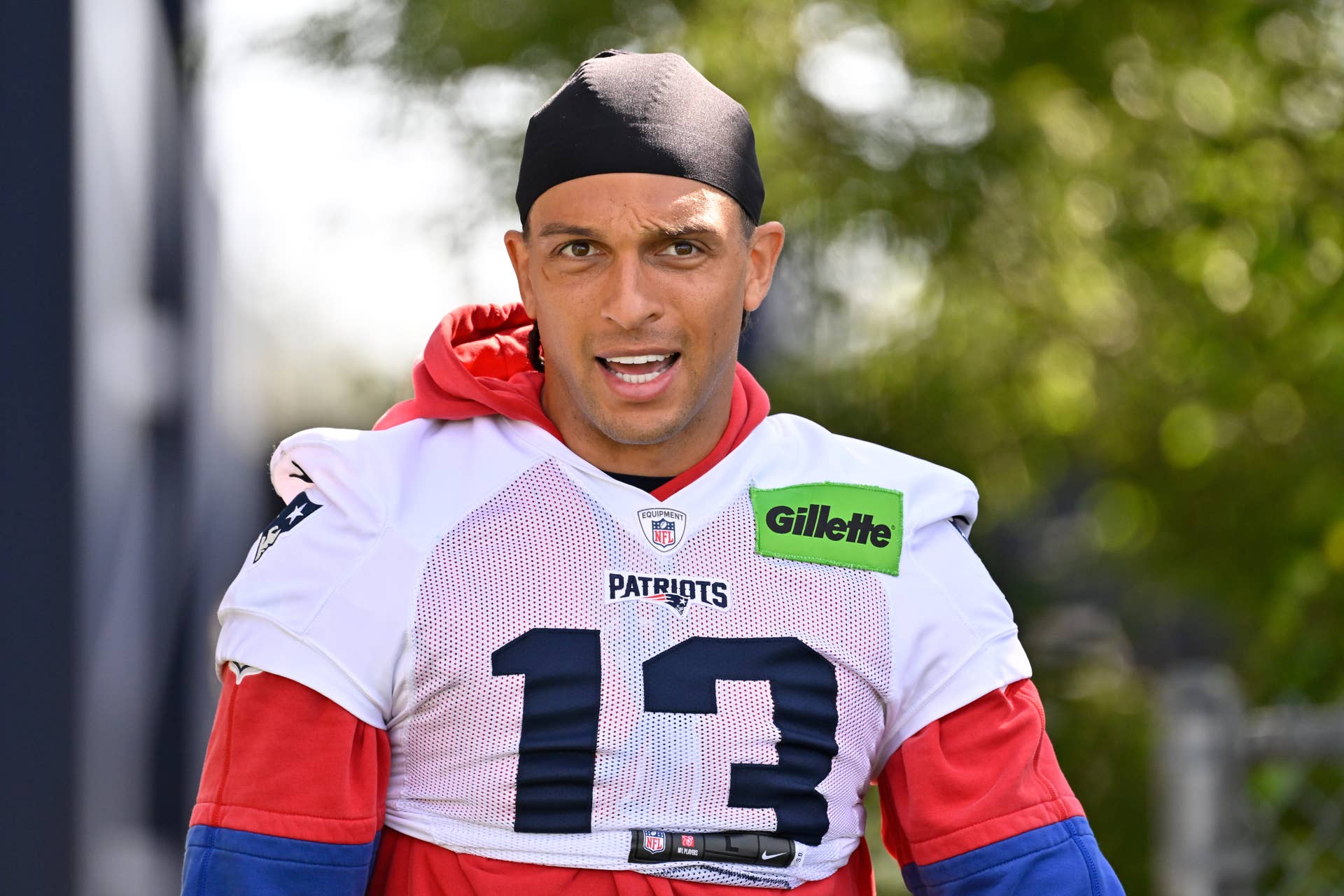
That is why Chism’s emergence is both exciting and complicated, because explosive catches can win games, but replacing a veteran like Hollins requires far more than simply producing one memorable highlight when the ball happens to travel in a receiver’s direction.
Still, Chism’s performance in Buffalo showed that he is not intimidated by high-pressure moments, and that alone could make him extremely difficult to push back down the depth chart if he continues earning Maye’s trust during critical situations.
The touchdown itself was especially telling, because Maye extended the play under pressure and trusted Chism in a one-on-one situation downfield, giving the young receiver an opportunity to make a difficult catch when the Patriots needed points most.
That kind of trust between quarterback and receiver can develop quickly after one successful moment, particularly when the quarterback sees a teammate respond correctly under pressure and finish a play that changes the outcome of an important divisional game.

If Hollins misses additional time, New England could experiment with several different combinations, potentially increasing Chism’s outside snaps while allowing Douglas to continue working underneath and giving Doubs more opportunities as one of Maye’s primary perimeter targets.
Kyle Williams could also become increasingly relevant, because injuries often create opportunities beyond the obvious replacement, and New England may need multiple receivers to absorb the routes, blocking duties, and formation responsibilities Hollins normally handles during a full offensive game plan.
That internal competition could ultimately strengthen the Patriots if several players respond well, because defensive coordinators become more uncomfortable when an offense can rotate receivers without dramatically changing its effectiveness or revealing which concepts are coming based on personnel.
But the opposite possibility cannot be ignored, because young receivers can struggle with consistency, route precision, coverage recognition, and communication, meaning Hollins’ absence could become more damaging if New England cannot reproduce the details he quietly provides.
That is why the next practice reports will matter significantly, because Hollins’ status could determine whether this becomes a short-term adjustment or a much larger reshuffling of roles that lasts several weeks and changes the structure of New England’s offense.
For Vrabel, the situation presents both risk and opportunity, because injuries are unavoidable in the NFL, but how a coaching staff responds to them can reveal whether a roster truly possesses the depth required to survive a long and unpredictable season.
For Maye, the challenge may be even more immediate, because quarterback rhythm depends heavily on timing, trust, and familiarity, and every change at receiver forces him to adjust where he expects players to be when pressure arrives or coverage suddenly changes.
That makes Chism’s readiness even more valuable, because he did not need several games to gradually become comfortable after Hollins exited; he stepped directly into a larger role and produced one of the biggest plays New England has made this season.
The performance also reinforces a larger message inside the Patriots locker room: roster status does not guarantee opportunity forever, and any player who performs when circumstances suddenly open the door can force coaches to reconsider the existing hierarchy.
Hollins will remain important whenever he returns, but Chism’s emergence creates a fascinating question the Patriots may eventually have to answer even after the veteran becomes healthy again: can they really reduce the role of a receiver who keeps producing?
That question could become even louder if Chism delivers another strong performance, because fans and analysts will inevitably begin asking whether the Buffalo touchdown was simply a memorable moment or evidence that New England had been underusing one of its most intriguing young players.
Doubs also has something to gain from the changing rotation, especially after producing six catches for 58 yards and two touchdowns against Buffalo, a performance that further established him as one of Maye’s most dangerous options when the offense reaches scoring territory.
With Hollins potentially unavailable, Doubs could see an even greater target share, giving him an opportunity to strengthen his status near the top of New England’s receiver hierarchy while forcing opposing defenses to devote more attention to his routes.
That could create opportunities elsewhere, particularly for Chism and Douglas, because increased defensive attention on Doubs may produce favorable matchups for receivers working against single coverage or finding space underneath linebackers and safeties.
The Patriots therefore face a strange contradiction: losing Hollins creates a legitimate problem, but the adjustment required by his absence could also help New England discover a more flexible and unpredictable receiving rotation than the one it originally planned to use.
Fans should be careful not to treat Hollins’ injury as insignificant simply because Chism delivered immediately, but they should also recognize that depth becomes valuable only when backups prove they can perform under real pressure.
Chism has now done exactly that, and Vrabel’s comments suggest New England is willing to reward him with additional opportunities, creating one of the most compelling internal competitions surrounding the Patriots offense as the season moves forward.
The next few games could ultimately reveal whether Hollins’ injury becomes merely a temporary disruption or the moment that permanently changes New England’s receiving hierarchy and introduces another legitimate weapon into Maye’s rapidly evolving offense.
For now, the message could not be clearer: one veteran went down, one young receiver stepped forward, and the Patriots may have discovered that “next man up” is more than a cliché when the next man is ready to change the game.


