SONIC BOOM BY THE BAY: The San Francisco 49ers Officially Unleash the Fastest Player in NFL History ⚡🏈
SANTA CLARA, CA — Just when NFL defensive coordinators thought Kyle Shanahan’s offensive scheme couldn’t possibly get any more terrifying, the San Francisco 49ers have successfully weaponized the sound barrier.
For the past week, the football world has been trapped in a dizzying arms race of unprecedented velocity. First, the Philadelphia Eagles broke the Next Gen Stats (NGS) speed record. Then, mere hours later, the Pittsburgh Steelers shattered it. But as of Wednesday morning, the Next Gen Stats servers have officially overheated, and the crown has moved to the Bay Area.
The NFL league office confirmed today that San Francisco 49ers rookie offensive weapon DeAndre “The Jetstream” Washington has officially registered the fastest ball-carrier speed in the history of human civilization. During a jaw-dropping 96-yard touchdown run against the division rival Los Angeles Rams on Sunday Night Football, Washington was clocked at a mathematically offensive 24.38 miles per hour in full pads.
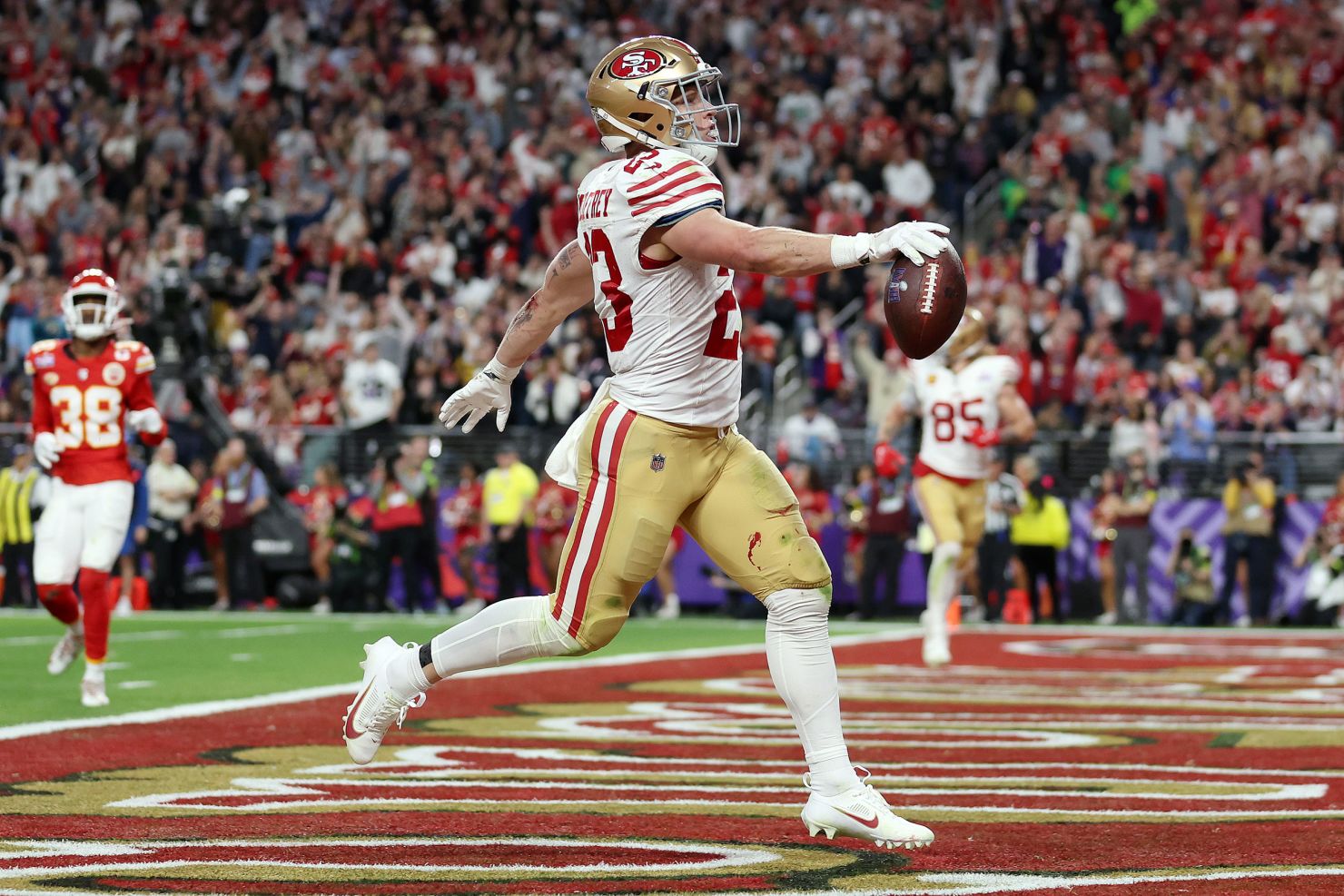
To put this escalating madness into perspective: Tyreek Hill’s long-standing gold standard was 23.24 MPH. The Eagles pushed it to 23.82 MPH. The Steelers answered with 24.15 MPH. Washington’s 24.38 MPH isn’t just a football statistic; it is a biomechanical anomaly that actively defies the laws of aerodynamics, turf friction, and common sense.
The Play That Broke the Matrix at Levi’s Stadium
The moment that will live forever in 49ers lore happened late in the third quarter. Backed up deep in their own territory on a 2nd-and-12, the 49ers dialed up a classic Kyle Shanahan concept: a pre-snap motion into a jet sweep.
Washington took the handoff from quarterback Brock Purdy at the 4-yard line. Initially, the Rams’ defense diagnosed the play perfectly. An unblocked edge rusher had a clean shot in the backfield, forcing Washington to violently plant his foot and reverse field. By the time he looped back toward the opposite sideline, three Rams defensive backs—including a safety who ran a 4.3-second 40-yard dash at the NFL Combine—had him dead to rights with perfect pursuit angles.
Then, Washington hit the afterburners.
The acceleration was so abrupt, so violent, that it looked as though the broadcast camera operator had accidentally hit the fast-forward button. Washington erased the defenders’ angles in a fraction of a second, bursting up the home sideline. By the time he crossed the 50-yard line, the Rams’ secondary wasn’t even in the camera frame anymore. He casually cruised into the end zone, having turned three world-class professional athletes into stationary traffic cones.
“I had him pinned against the boundary. I broke down, I squared up, and I reached out to make the tackle,” a visibly shell-shocked Rams safety told reporters in the locker room. “My hands literally grabbed empty air. I didn’t even touch his jersey. I’ve been playing football my entire life, and my brain physically could not process the speed he was moving at. It’s like trying to tackle a laser beam.”
The Science of “The Jetstream”
When the NFL headquarters received the 24.38 MPH readout from the tracking chips inside Washington’s shoulder pads, engineers immediately assumed the Levi’s Stadium Wi-Fi had caused a data corruption. After running an exhaustive diagnostic on the equipment, they were forced to accept the impossible reality.
A former Olympic track hopeful out of a powerhouse SEC track program, the 6-foot-1, 195-pound Washington possesses a rare genetic makeup. While most speedsters lose elite top-end velocity when carrying the weight of a football helmet and Kevlar-lined pads, Washington’s stride frequency remains completely unaffected. His ground-contact time is so minimal that sports scientists estimate he is absorbing virtually no kinetic drag from the grass.
“To eclipse 24.3 miles per hour while executing a football maneuver, wearing 18 pounds of equipment, is a physiological miracle,” a lead sports biomechanist explained on ESPN this morning. “He is generating a level of force production into the ground that we usually only see from Olympic sprinters running in spikes on a perfectly tuned synthetic track. If you put him in the 100-meter dash in standard running gear, he is pushing 29 MPH. It’s an absolute cheat code.”
Kyle Shanahan’s Ultimate Chess Piece
Head coach Kyle Shanahan, the mad scientist of modern NFL offenses, is notorious for his ability to scheme players wide open into acres of space. Giving him a player who runs 24.38 MPH borders on a violation of the Geneva Conventions.
During his Monday press conference, Shanahan couldn’t hide a smug, knowing smile when asked about his rookie sensation.
“We knew DeAndre had a different gear when we drafted him, but Sunday was… different,” Shanahan said, shaking his head. “As a play-caller, it completely changes the geometry of the field. You draw up a play expecting to gain eight yards if the blocking holds up. With him, if a linebacker takes one half-step in the wrong direction, the play is over and the band is playing the fight song. He bends the defensive structure until it breaks.”
The San Francisco offense is already a nightmare of positionless football, featuring Christian McCaffrey, Deebo Samuel, George Kittle, and Brandon Aiyuk. Injecting the fastest human being in NFL history into that ecosystem is a schematic doomsday device.
Defensive Coordinators Are Surrendering
The ripple effect of Washington’s verified speed is already tearing apart the fabric of NFC game-planning. Defensive coordinators are publicly admitting they have no answers.
“How do you defend it? Honestly, tell me,” an anonymous NFC West defensive coordinator ranted on a coaching podcast this week. “If you play off-coverage to respect the deep ball, Shanahan throws him a one-yard screen and he outruns your entire defense to the pylon. If you press him, he blows by your corner in one second. You have to put two safeties 25 yards deep just to keep him in front of you, which means McCaffrey is going to run for 200 yards up the middle against light boxes. It’s a lose-lose scenario.”
As the San Francisco 49ers march toward the playoffs, they find themselves armed with a weapon that fundamentally breaks the geometry of the sport. In a league where billions of dollars are spent trying to find the slightest competitive edge, the 49ers have opted for something much simpler: sheer, unadulterated velocity.
The Bay Area has officially unleashed the fastest man in football history. And as the rest of the NFL is quickly realizing, no defensive scheme in the world can stop what it cannot catch.


