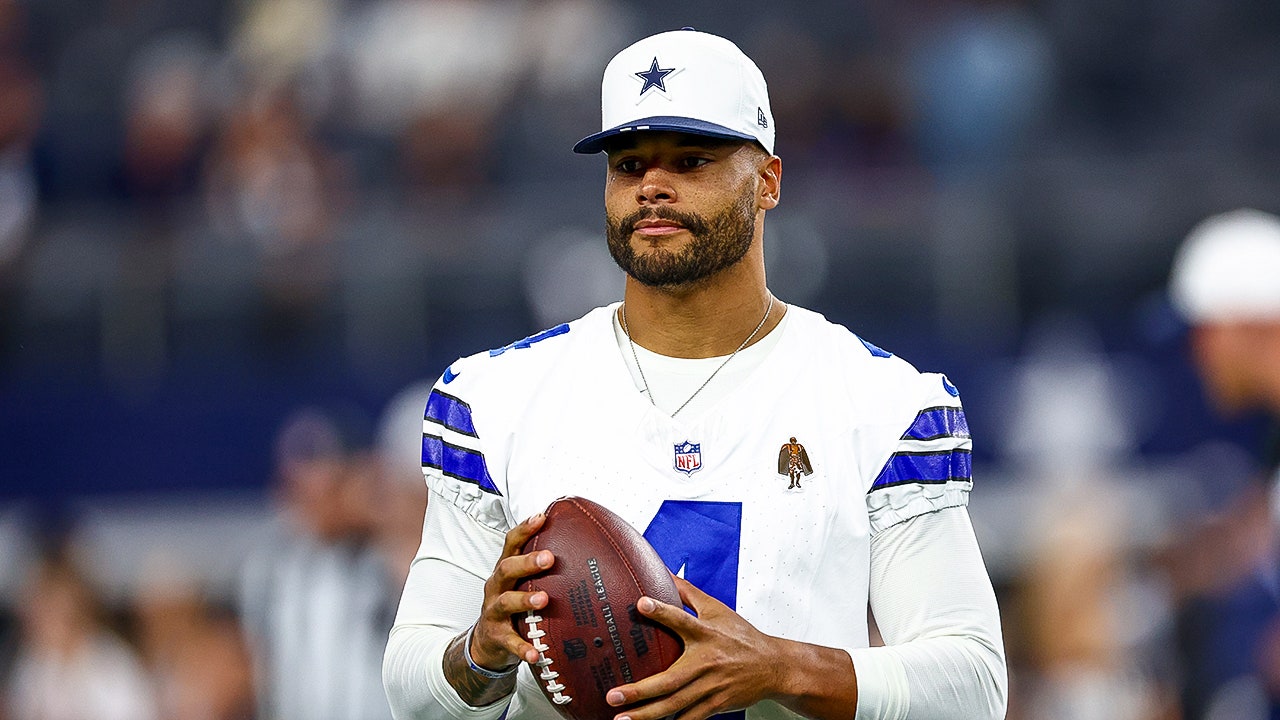
The celebration after a Dallas Cowboys victory was supposedly about football, but a remarkable story circulating online describes Dak Prescott doing something that reportedly caught everyone nearby off guard, turning away from the excitement and approaching an elderly stadium cleaner whose quiet work had gone largely unnoticed by the departing crowd.
According to the account, the 33-year-old quarterback did not immediately head toward the locker room or remain surrounded by teammates celebrating the result, but instead walked toward the stands, where a woman believed to be over 75 years old was collecting discarded cups, wrappers, and rubbish left behind by spectators.
What happened next is the detail that gives the story its emotional force, as Prescott allegedly lowered himself onto one knee, gently took the woman’s hand, and placed a clean towel into it, offering a moment of personal attention that stood in striking contrast to the noise surrounding a professional football victory.
The circulating narrative claims that he then spoke a single sentence, quietly enough to make the encounter feel personal rather than theatrical, and that those words carried a meaning the elderly woman would remember long after the stadium emptied and the celebrations moved elsewhere.
The story has attracted attention because it presents a different image of a famous quarterback, shifting the focus away from passing statistics, touchdowns, and postgame interviews toward the people whose contributions often remain invisible while thousands of fans enjoy the spectacle of professional football.
However, the specific encounter described here has not been independently verified, and the location raises an important question: Lincoln Financial Field is the Philadelphia Eagles’ home stadium, so a Cowboys victory there is possible in an away game, but the circumstances, the woman’s identity, and Prescott’s alleged words require reliable confirmation before the story can be treated as factual reporting.
That distinction does not diminish the broader message behind the narrative, because stadium cleaners perform essential work that is rarely acknowledged by the crowds who leave behind the mess, often continuing their duties long after the excitement of a game has faded.
For many spectators, the final whistle marks the end of an unforgettable afternoon, but for the people responsible for maintaining the venue, it can signal the beginning of hours of demanding work involving discarded food containers, cups, packaging, and other debris scattered throughout the seating areas.
The contrast is particularly striking when an athlete whose face is recognized by millions allegedly pauses to acknowledge someone whose work might otherwise attract little attention, reminding observers that a person’s importance cannot reasonably be measured by fame, salary, or public visibility.
If the reported gesture occurred as described, the image of Prescott kneeling beside the elderly worker would carry significance beyond the towel itself, symbolizing a willingness to meet another person with respect rather than allowing the difference in their public profiles to determine how they interact.
Yet the most intriguing part of the story remains the sentence Prescott allegedly spoke, because the narrative suggests that his words mattered more than any expensive gift or elaborate public announcement could have mattered in that moment.
Without a verified quotation, it would be irresponsible to invent the sentence or claim that it transformed the woman’s life, particularly when such a statement implies personal consequences that only the people involved could accurately explain.
Still, the possibility that a brief expression of appreciation could deeply affect someone is a powerful reminder of how easily ordinary workers can feel overlooked, especially in environments where the attention naturally gravitates toward athletes, celebrities, and the excitement of major sporting events.
A sincere acknowledgment does not erase the physical demands of a difficult job, resolve financial concerns, or change every circumstance in someone’s life, but it can communicate something meaningful: that another person has noticed the effort being made and considers it worthy of respect.
That principle reaches far beyond football, applying equally to custodians, maintenance workers, restaurant employees, healthcare staff, and countless others whose daily contributions allow public spaces and essential services to function smoothly.
For Prescott, the reported moment would offer a different kind of story from the familiar narratives surrounding a franchise quarterback, whose performances are frequently examined through wins, losses, passing yards, leadership decisions, and expectations that accompany his position.
Professional athletes are often celebrated for extraordinary achievements, but their interactions away from competition can also influence how supporters understand the people behind the uniforms, especially when those interactions appear to place compassion ahead of attention or personal convenience.
The emotional appeal of this particular account comes from the contrast between a major football star and an elderly woman performing a task that many spectators might overlook, creating a narrative in which recognition itself becomes the central gesture.
Some readers may find the story inspiring because it emphasizes dignity and kindness, while others may reasonably question whether the dramatic details have been exaggerated to attract attention online, particularly because the alleged sentence and its life-changing consequences remain unspecified.
Both reactions are worth considering, because meaningful acts of kindness deserve appreciation, but stories involving real people also deserve accurate reporting that separates confirmed details from claims that have not been independently established.
The setting makes verification especially important, since Lincoln Financial Field is associated with the Eagles and the Cowboys are one of their most prominent rivals, a context that could make an encounter involving Prescott particularly memorable if reliable evidence eventually emerges.
If footage, a credible eyewitness account, or a statement from the stadium worker were to confirm the incident, those details could help explain what actually happened, what Prescott said, and whether the encounter had the lasting impact described in the circulating narrative.
Until then, readers should avoid treating the story as confirmed news or assuming that the elderly woman experienced specific personal changes simply because the headline promises an extraordinary outcome.
Nevertheless, the broader question remains worth discussing: why do moments of kindness toward people performing overlooked work sometimes leave such a strong impression, especially when they involve individuals who are usually surrounded by cameras, crowds, and public expectations?
Perhaps the answer lies in the simplicity of the gesture, because respect does not require a championship ring, an enormous donation, or a speech delivered before thousands of spectators, but only the willingness to recognize another person’s dignity.
If Dak Prescott truly stopped after a Cowboys victory to acknowledge a stadium cleaner at Lincoln Financial Field, the encounter would offer a compelling reminder that the most memorable moments in sports are not always the ones recorded on the scoreboard.
And the question that keeps this story intriguing is not merely what the quarterback allegedly placed in the woman’s hand, but what he actually said—and whether the real story behind that quiet exchange can be confirmed beyond the emotional headline.


