Jason Kelce has become the center of a growing conversation surrounding Saquon Barkley after a powerful statement attributed to the former Philadelphia Eagles center challenged the criticism directed at the star running back, raising difficult questions about loyalty, accountability, and how quickly a celebrated athlete can become a target when expectations collide with reality.
The message strikes at the heart of Philadelphia football, where passion has always been inseparable from demanding standards, and where players who once received standing ovations can suddenly find themselves facing uncomfortable scrutiny when their performances fail to match the hopes of an intensely devoted fan base.
“What’s happening to him is a crime against football—a blatant betrayal of everything this sport stands for,” Kelce reportedly declared in the circulating statement, expressing outrage at what he viewed as unfair treatment of a player who has consistently been expected to shoulder an enormous responsibility for the Eagles’ offense.
Those words carry particular emotional weight because Kelce understands the unique relationship between Philadelphia and its athletes, having spent years experiencing the pressure, expectations, celebrations, and frustrations that come with representing a franchise whose supporters demand extraordinary commitment from everyone wearing the midnight-green uniform.
For Barkley, the situation described in the statement highlights a difficult reality of professional football, where outstanding achievements can quickly become yesterday’s news and where a player’s reputation may be judged by the latest performance rather than the larger body of work that brought him to prominence.
The debate is not simply about whether Barkley deserves criticism, because every professional athlete must be evaluated on performance, consistency, and contribution, but whether those conversations remain fair when disappointment begins overshadowing the effort, commitment, and circumstances behind what happens on the field.
Kelce’s reported defense challenges Philadelphia supporters to consider that distinction, particularly when discussing a running back whose role demands physical punishment, patience, and the ability to keep fighting even when defensive schemes, offensive execution, or game situations make success considerably more difficult.
“How could anyone be so cruel?” the statement continued, confronting the harshness that can emerge when sports discussions move beyond tactical analysis and become personal judgments about a player’s character, dedication, or worth to the organization he represents.
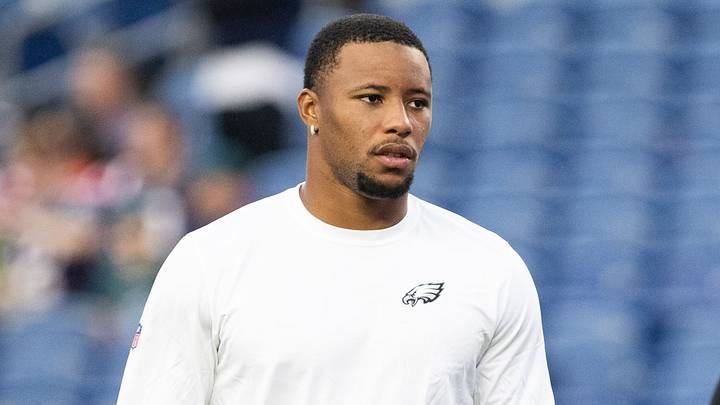
That question is likely to resonate with Eagles fans who believe criticism should never erase a player’s contributions, although others may argue that passionate supporters have every right to demand accountability when a highly regarded athlete is not meeting expectations.
The disagreement reveals one of the most complicated aspects of modern football fandom, where supporters can simultaneously appreciate a player’s achievements and question his recent performances, yet online conversations frequently turn that complicated reality into an argument between unconditional loyalty and relentless criticism.
Barkley occupies a particularly fascinating position in that debate because running backs operate in one of football’s most physically demanding roles, absorbing repeated contact while depending on blocking assignments, play design, defensive alignment, and the overall rhythm of the offense to create opportunities.
Even when a running back appears to be struggling, the final statistics rarely explain every factor involved, and a disappointing afternoon may reflect a combination of individual execution, offensive-line performance, defensive adjustments, and circumstances that cannot reasonably be reduced to one person’s responsibility.
That context does not eliminate the need for honest evaluation, but it makes sweeping judgments considerably more complicated, especially when fans expect a player to deliver spectacular results regardless of the challenges surrounding him.
The statement attributed to Kelce places particular emphasis on Barkley’s willingness to keep competing, describing a player who gives everything to the team without demanding constant attention or shifting responsibility onto teammates whenever circumstances become difficult.
“He has carried this offense with his whole heart, showing up week after week, playing through pain, giving everything he has—all without ever seeking the spotlight or casting blame on anyone else—only to fight his absolute hardest for Philadelphia,” the circulating statement reads.
The emotional force of that message comes from its portrayal of leadership as something deeper than highlights, interviews, or individual accolades, suggesting that a player’s commitment should remain part of the conversation even when the scoreboard creates disappointment.
Philadelphia has long valued toughness, resilience, and accountability, but those qualities can produce conflicting expectations when supporters demand both relentless effort and immediate results, particularly from players whose reputations have been built around changing the outcome of games.
For some fans, Kelce’s reported words will sound like a necessary reminder that Barkley deserves perspective and appreciation rather than condemnation after every difficult performance, while others may interpret the message as an attempt to soften legitimate questions about offensive production.
Neither position automatically settles the debate, because respecting an athlete and evaluating his performance are not mutually exclusive, and a healthy football discussion should allow supporters to recognize past contributions while examining present challenges honestly.
The larger issue is whether Philadelphia’s football culture can maintain its demanding identity without allowing frustration to overshadow the human beings responsible for delivering the performances supporters expect, especially when social media rewards the sharpest accusations rather than the most balanced explanations.
Kelce’s connection to the Eagles makes the message particularly compelling, because his years in Philadelphia established him as a figure closely associated with the team’s identity, its demanding supporters, and the emotional bond between players and the city they represent.
His perspective therefore carries symbolic significance for many fans, even though the circulating quotation itself should not be treated as independently verified without a reliable source confirming that Kelce made those exact remarks.
That distinction matters, because a compelling sports narrative can spread rapidly when it features recognizable names and emotionally charged language, but the popularity of a quotation does not establish that it was genuinely spoken by the person to whom it is attributed.
Still, the underlying debate deserves attention regardless of the quotation’s verification, because Barkley’s situation illustrates the tension between demanding excellence and recognizing the complicated realities of performing under constant public scrutiny.
Every season brings new expectations, new tactical challenges, and new opportunities for supporters to reconsider their opinions, yet the strongest reactions often emerge when the difference between what fans expect and what they witness becomes impossible to ignore.
For Barkley, the challenge is to continue contributing to Philadelphia’s ambitions while navigating the attention that comes with being one of the offense’s most recognizable figures, knowing that both praise and criticism can intensify dramatically after a single game.
For Eagles supporters, the challenge is different: deciding how to hold a star accountable without allowing one performance, one statistic, or one difficult stretch to define an entire player’s value to the franchise.
Ultimately, the controversy surrounding the reported statement raises a question that reaches beyond Saquon Barkley and Jason Kelce: does loyalty mean defending a player against every criticism, or does it mean demanding better while still respecting everything that player brings to the team?
Philadelphia’s answer may never be unanimous, because passionate football communities rarely agree on where accountability ends and unfair treatment begins, but that disagreement is precisely why conversations about beloved players can become so emotional.
One thing remains clear: the relationship between the Eagles and their supporters has always been built on enormous expectations, fierce debate, and an unshakable desire to win, making the treatment of a high-profile player like Barkley about far more than rushing yards alone.
And if the words attributed to Kelce reflect the position he genuinely holds, their most important message is not that Barkley should escape scrutiny, but that criticism should never erase the effort, commitment, and respect that professional athletes deserve while fighting for Philadelphia.


